
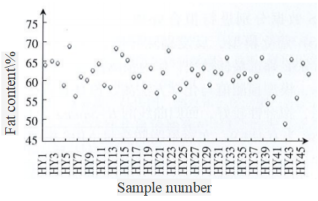
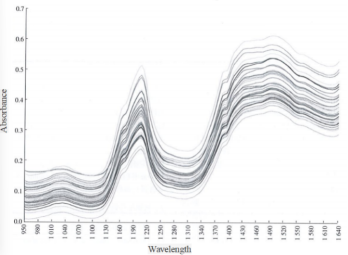
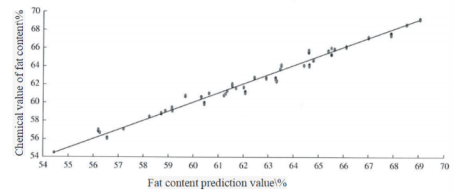
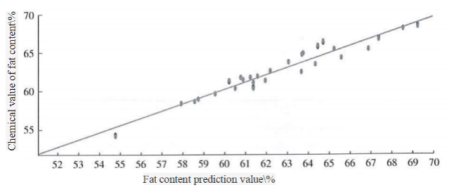
In order to realize the nondestructive and rapid detection of fat content of Xanthoceras sorbifolia and meet the screening of breeding materials and industrial processing requirements of X.sorbifolia, 46 X.sorbifolia were selected as the standard sample set, the results showed that the fat content of 46 apricot kernel kernels was 49.38%~68.98% an average content of 61.62%. The fat content of the seed kernel was determined by the Soxhlet extraction method, and the spectral data of the sample was collected by the near-infrared spectroscopy (NIRS) technology, and the Unscrambler software was used to construct the NIRS prediction model of X.sorbifolia fat content by the partial least squares (PLS) method. The results showed that the regression curve R-Square (determination coefficient) of the model was 0.9856, and the RMSE (standard error) was 0.4149, which could be used for effective prediction. At the same time, 32 X.sorbifolia samples not participating in the modeling were selected as validation materials to further carry out external test on the prediction effect of the model. The results showed that the external test regression curve R-Square was 0.9014, RMSE was 0.8259, and the predicted value of fat content was in good agreement with the chemical value.
| Published in | Agriculture, Forestry and Fisheries (Volume 14, Issue 6) |
| DOI | 10.11648/j.aff.20251406.11 |
| Page(s) | 226-231 |
| Creative Commons |
This is an Open Access article, distributed under the terms of the Creative Commons Attribution 4.0 International License (http://creativecommons.org/licenses/by/4.0/), which permits unrestricted use, distribution and reproduction in any medium or format, provided the original work is properly cited. |
| Copyright |
Copyright © The Author(s), 2025. Published by Science Publishing Group |
Xanthoceras Sorbifolium, Fat Content, NIRS, Prediction Model
NIRS | Near-Infrared Spectroscopy |
RMSE | Root Mean Square Error |
PLS | Partial Least Squares |
R-Square | Determination Coefficient |
| [1] | Chen Ou, Dong Fengliang, Ma Haiyuan, Zheng Shuqing, Ma Tjun, Jia Changxi. Extraction and Analysis of Physicochemical Properties and Fatty Acid Composition of Xinghua Fruit Oil. Journal of Beijing College, 2013, 28(1): 78-80. |
| [2] | Sun Linlin, Zhao Dengchao, Hanuanming, Luan Senian, Hou Liquan. Genetic Analysis of Economic Fruit Traits of Xinghua Fruit Tree Plants. Shand Agricultural Science, 2012, 44(1): 25-28. |
| [3] | Hao Xuesong, Chen Pu, D Jiawei, Wang Haipeng, Liu Dan, Li Jingyan, Xu Yupeng, Chu Xiaoli. Application Progress and Prospect of Miniature NearInfrared Spectrometer. Journal of Analytical Testing, 2022, 41(9): 1301-1313. |
| [4] | Zheng Niannian, Luan Xiaoli, Liu Fei. Near-Infrared Spectroscopy Modeling Technology Based on Adaptive Elastic Net. Spectroscopy and Spectral Analysis, 2019, 39(1): 319-324. |
| [5] | Shang Jing, Zhang Yan, Meng Qinglong. Identification of Apple Varieties by Spectral Technology Combined with Chemometrics. Northern Horture, 2019(16): 66-71. |
| [6] | Wang Siling, Cai Chen, Ma Huiqing, Longilin. Non-Destructive Detection of Apple Bitter Pit Based on Hyperspectral Imaging. Northern Horticulture, 2015(08): 124-130. |
| [7] | Zhang Shengsheng. Research on Quality Control of Traditional Chinese Medicine Shui Niu Jiao Based on Near-Infrared Spectroscopy. Guiyang: Guizhou Normal University, 2022. |
| [8] | Chen Ziyun, Huang Xiaoxia, Yao Wanqing, Peng Mengxia. Rapid detection of the content of citral in Litsea cubeba essential oil by near-infrared spectroscopy combined with partial least squares method. Anhui Chemical Industry, 2022, 48(1): 121-124. |
| [9] | Wang Shengpeng, Zheng Pengcheng, Gong Zhiming, Liu Panpan, Gao Shiwu, Teng Jing, Gui Anhui, Wang Xueping, Ye Fei, Zheng Lin. Rapid non-destructive evaluation of the taste quality of tea soup in green brick tea by near-infrared spectroscopy. Journal of Central China Agricultural University, 2020, 39(3): 113-119. |
| [10] | Yan Kewei, Wang Fu, Mei Guorong, Lu Junyu, Zhang Lan, Fu Guilan, Chen Lin, Liu Youping, Chen Hongping. Establishment of a rapid qualitative discrimination model for Guangxiangpi based on near-infrared spectroscopy technology. Chinese Journal of Chinese Materia Medica, 2015, 46(20): 3096-3099. |
| [11] | Wang Yun, Xu Kexin, Chang Min. Establishment of calibration model for the detection of fat and protein content in milk by near-infrared spectroscopy technology. Optical Instruments, 2006(3): 3-7. |
| [12] | Geng Xiang, Zhou Liping, Ma Xinxin, Jiang Longfa, Yang Weigen. Research on rapid determination method of oil content and moisture in tea cake based on near-infrared spectroscopy. Anhui Agricultural Science Bulletin, 2017, 23(16): 130-132 171. |
| [13] | Na Rong, Ren Jindong, Hu Bo, Zhao Qiang, Lei Xi. Research on the establishment of rapid analysis model of alfalfa nutritional components based on different pretreatment methods. Journal of Animal Ecology, 2021, 42(12): 37-43. |
| [14] | Geng Lig, Song Chunfeng, Wang Lina, An Xuesong, Sun Juan. Research on the method of nondestructive determination of soybean seed vitality by near-infrared spectroscopy. Journal of Plant Genetic Resources, 2013, 14(6): 1208-1212. |
| [15] | Yang Shuhan. Design and Research of Cotton Moisture Content Detection System Based on Near-Infrared. Xi'an: Xi'an University of Technology, 2021. |
| [16] | Wang Zhiwei, Wang Xiuzhen, Ma Lang Liu Ting, Tang Yueyi, Wu Qi, Sun Quanxi, Wang Chuangang. Construction of Near-Infrared Analysis Model for Edible Sens Quality of Peanut Kernel. Peanut Science, 2022, 51(3): 77-82. |
| [17] | Mzimbiri Rehema Idriss. Research on the Method of Determining the Content of Oleic Acid and Linoleic Acid in Pean Seeds and Peanut Oil Based on Hyperspectral Imaging Technology and Near-Infrared Spectroscopy. Beijing: Chinese Academy of Agricultural Sciences, 016. |
| [18] | Ji Hongchang, Qiu Xiaocheng, Liu Wenhao, Hu Changli, Kong Ming, Hu Xiaui, Huang Jianbin, Yang Xue, Tang Yan, Zhang Xiajun, Wang Jingshan, Qiao Lipian. Construction and Application of Near-Infrared for Oil Content in Peanut Kernels. Journal of Chinese Oil Crop, 2022, 44(5): 189-1097. |
| [19] | Zhou Qingmei, Wang Gang, Wang Rong, Chen Shuang, Guo Liy. Feasibility Analysis of Near-Infrared Technology Applied to the Determination of Moisture and Acid Value of Rice. China and Foreign Liquor, 2021(21): 14-17. |
| [20] | Fang Yan. Research on the Non-Destructive Determination of Cornernel Crude Starch Content by Near-Infrared Spectroscopy. Crop Journal, 2011, 141(2): 5-27. |
| [21] |
GB 5009.6—2016, National Food Safety Standard Determination of Fat in Food [S].
https://max.book118.com/html/2020/1107/7152053151003014.shtm |
| [22] | Li Junxia, Zhang Hongliang, Yan Yanlu, Min Shungeng, Li Zichao. Creation and Application of Near-Infrareditative Model for Rice Protein in Breeding. Chinese Agricultural Science, 2006, 39(4): 836-81. |
| [23] | Lv Longfei, Zhang Miaomiao, Bao Xiang, et al. Construction of a Model for Predicting the Content Routine Nutritional Components in Whole Corn Silage Based on Near-Infrared Reflectance Spectroscopy. Animal Nutrition, 1-1 [2025-10-16]. |
| [24] | Hu Yichao, Dai Suming, Sun Jiansheng, et al. Research on the Early Aging Process of Tobacco Leaves on Near-Infrared Spectroscopy Technology. Biomass Chemical Engineering, 2025, 59(05): 87-4. |
APA Style
Chao-hong, G., Wei-ming, L., Hai-long, Z. (2025). Establishment and Verification of Near-infrared Spectral Prediction Model for Fat Content of Xanthoceras Sorbifolia. Agriculture, Forestry and Fisheries, 14(6), 226-231. https://doi.org/10.11648/j.aff.20251406.11
ACS Style
Chao-hong, G.; Wei-ming, L.; Hai-long, Z. Establishment and Verification of Near-infrared Spectral Prediction Model for Fat Content of Xanthoceras Sorbifolia. Agric. For. Fish. 2025, 14(6), 226-231. doi: 10.11648/j.aff.20251406.11
AMA Style
Chao-hong G, Wei-ming L, Hai-long Z. Establishment and Verification of Near-infrared Spectral Prediction Model for Fat Content of Xanthoceras Sorbifolia. Agric For Fish. 2025;14(6):226-231. doi: 10.11648/j.aff.20251406.11
@article{10.11648/j.aff.20251406.11,
  author = {Ge Chao-hong and Li Wei-ming and Zhao Hai-long},
  title = {Establishment and Verification of Near-infrared Spectral Prediction Model for Fat Content of Xanthoceras Sorbifolia
},
  journal = {Agriculture, Forestry and Fisheries},
  volume = {14},
  number = {6},
  pages = {226-231},
  doi = {10.11648/j.aff.20251406.11},
  url = {https://doi.org/10.11648/j.aff.20251406.11},
  eprint = {https://article.sciencepublishinggroup.com/pdf/10.11648.j.aff.20251406.11},
  abstract = {In order to realize the nondestructive and rapid detection of fat content of Xanthoceras sorbifolia and meet the screening of breeding materials and industrial processing requirements of X.sorbifolia, 46 X.sorbifolia were selected as the standard sample set, the results showed that the fat content of 46 apricot kernel kernels was 49.38%~68.98% an average content of 61.62%. The fat content of the seed kernel was determined by the Soxhlet extraction method, and the spectral data of the sample was collected by the near-infrared spectroscopy (NIRS) technology, and the Unscrambler software was used to construct the NIRS prediction model of X.sorbifolia fat content by the partial least squares (PLS) method. The results showed that the regression curve R-Square (determination coefficient) of the model was 0.9856, and the RMSE (standard error) was 0.4149, which could be used for effective prediction. At the same time, 32 X.sorbifolia samples not participating in the modeling were selected as validation materials to further carry out external test on the prediction effect of the model. The results showed that the external test regression curve R-Square was 0.9014, RMSE was 0.8259, and the predicted value of fat content was in good agreement with the chemical value.
},
 year = {2025}
}
TY  - JOUR
T1  - Establishment and Verification of Near-infrared Spectral Prediction Model for Fat Content of Xanthoceras Sorbifolia

AU  - Ge Chao-hong
AU  - Li Wei-ming
AU  - Zhao Hai-long
Y1  - 2025/11/22
PY  - 2025
N1  - https://doi.org/10.11648/j.aff.20251406.11
DO  - 10.11648/j.aff.20251406.11
T2  - Agriculture, Forestry and Fisheries
JF  - Agriculture, Forestry and Fisheries
JO  - Agriculture, Forestry and Fisheries
SP  - 226
EP  - 231
PB  - Science Publishing Group
SN  - 2328-5648
UR  - https://doi.org/10.11648/j.aff.20251406.11
AB  - In order to realize the nondestructive and rapid detection of fat content of Xanthoceras sorbifolia and meet the screening of breeding materials and industrial processing requirements of X.sorbifolia, 46 X.sorbifolia were selected as the standard sample set, the results showed that the fat content of 46 apricot kernel kernels was 49.38%~68.98% an average content of 61.62%. The fat content of the seed kernel was determined by the Soxhlet extraction method, and the spectral data of the sample was collected by the near-infrared spectroscopy (NIRS) technology, and the Unscrambler software was used to construct the NIRS prediction model of X.sorbifolia fat content by the partial least squares (PLS) method. The results showed that the regression curve R-Square (determination coefficient) of the model was 0.9856, and the RMSE (standard error) was 0.4149, which could be used for effective prediction. At the same time, 32 X.sorbifolia samples not participating in the modeling were selected as validation materials to further carry out external test on the prediction effect of the model. The results showed that the external test regression curve R-Square was 0.9014, RMSE was 0.8259, and the predicted value of fat content was in good agreement with the chemical value.

VL  - 14
IS  - 6
ER  -
Cotton Research Institute, Hebei Academy of Agriculture and Forestry Sciences, Shijiazhuang, China
Cotton Research Institute, Hebei Academy of Agriculture and Forestry Sciences, Shijiazhuang, China
Shijiazhuang Seed Management Station, Shijiazhuang, China

Information



 Share This Article
 Twitter
 Linked In
 Facebook
 Copy
Copy Download